How to Start Using AI for Research Today: My Minimalist Approach for Maximal Impact (Without the Overwhelm)
|
Read at RisingResearcherAcademy.com. You don’t need better AI tools. You need a better AI setup. Most people are using AI like it’s still 2023. Quick chats. Random questions. No context. Default settings. But here’s the truth: AI has evolved. Most researchers haven’t. If you want to make AI work for your research—not just play with it—you need to treat it less like a toy and more like a teammate. I am going to show you how in this post. Not with a million tools. Not with some fancy plug-ins. Just one powerful system, set up the right way. Minimal. Repeatable. Research-ready. Here’s how you can start using AI effectively for your research right now: Step 1: Choose Your System WiselyThe number one question I get asked at every conference — “What AI tool do you use for research?” And people are often surprised by my answer. With hundreds of AI tools on the market, I mostly stick with one: ChatGPT. My MINIMALIST approach to AI in Research:↳ I keep my AI toolkit simple. ↳ No fancy gimmicks or dozens of apps. ↳ Just one main tool that delivers: ChatGPT. 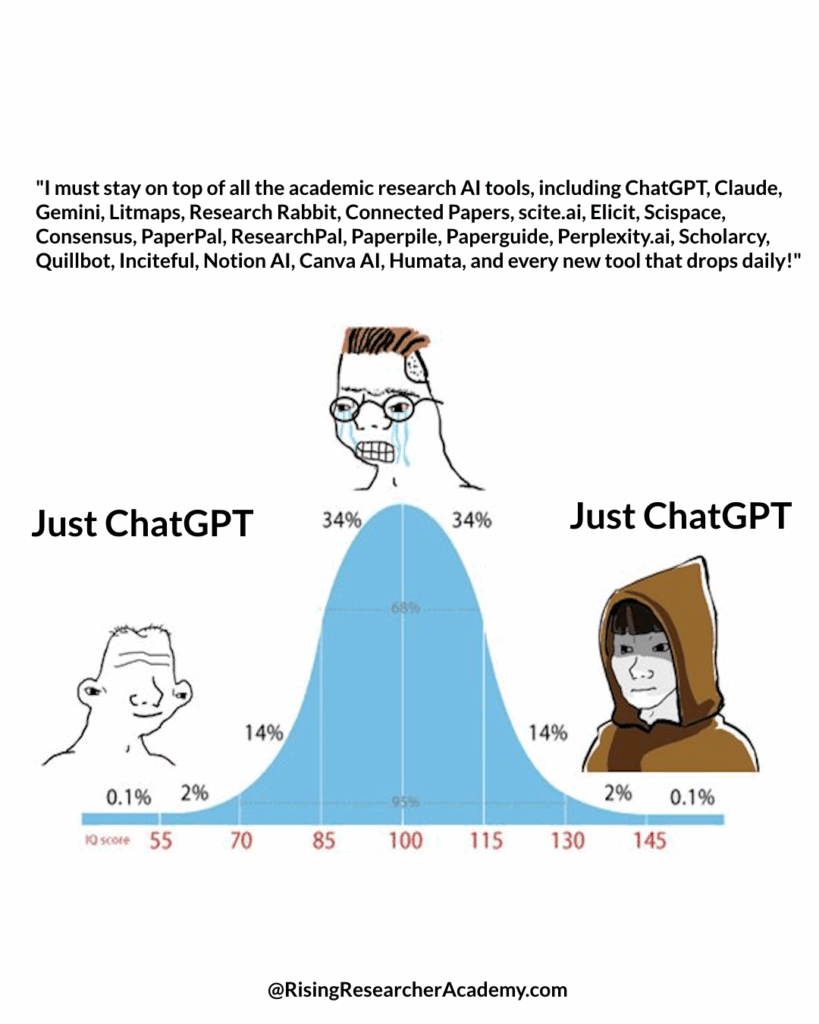 That’s not to say I haven’t explored. As an AI enthusiast, I test almost every major AI tool. Some have impressed me. Others didn’t. I subscribe to ChatGPT, Claude, and Gemini. I test almost everything. Some tools are impressive. Some… not so much. If ChatGPT gives me a weak output, I’ll compare it in Claude or Gemini. But 90% of the time – I stay in ChatGPT. Because when you’re trying to write a paper, solve a coding bug, or outline a grant—you don’t want to spend your time hopping tools. You want to focus. And focus requires simplicity. Think about it: How many statistical tools do you actually use? One or two, right? For me, it’s STATA and R. That’s it. Same with AI. The fewer tools, the deeper the mastery. The deeper the mastery, the better the output. So if you’re serious about bringing AI into your research workflow, pick one of these: → ChatGPT (GPT-4o) → Gemini (Pro 1.5) → Claude (Opus) Yes, there are apps marketed as “AI for researchers.” I’ve tried them. But truthfully? You’ll get more power and flexibility by learning how to prompt well in these foundational models. 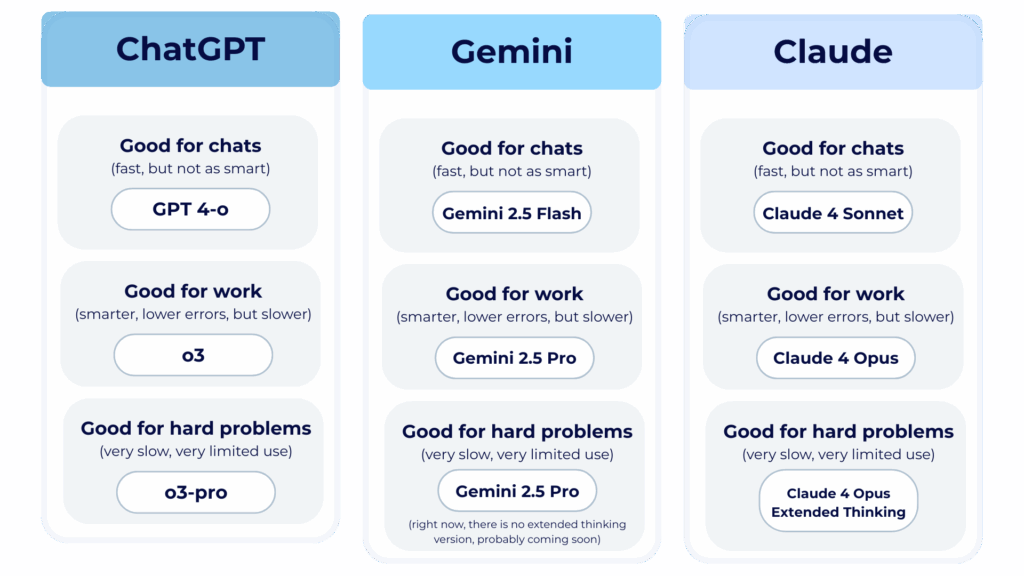 (Source: adapted from Ethan Mollick) These aren’t just chatbots anymore. They’re researchers. Editors. Statisticians. Writing partners. And for $20/month? You get multimodal reasoning, file uploads, citation tools, and code generation. If you’re still on the free version, you’re not using the tool. You’re using the demo. Here’s how I use them
Pro tip: Most tools default to faster, less capable models. Make sure you switch to the most powerful version manually. Another tip – When I’m stuck, I rotate between models. For example, when troubleshooting complex code, I’ve run the same problem through ChatGPT, Claude, and Gemini. If one hits a wall, the others often find a path. Step 2: Setting Your System RightBefore you start using AI for real research work, get your foundation right. Privacy, personalization, and project setup—this is where it begins. First: Adjust Your Privacy SettingsEven with de-identified data, privacy matters in research. Here’s what most people don’t realize: → Claude does not use your data to train future models. → ChatGPT and Gemini might—unless you change the settings. Let’s fix that first. For Gemini → Go to: Settings → Activity → Then click Turn Off Gemini Apps Activity 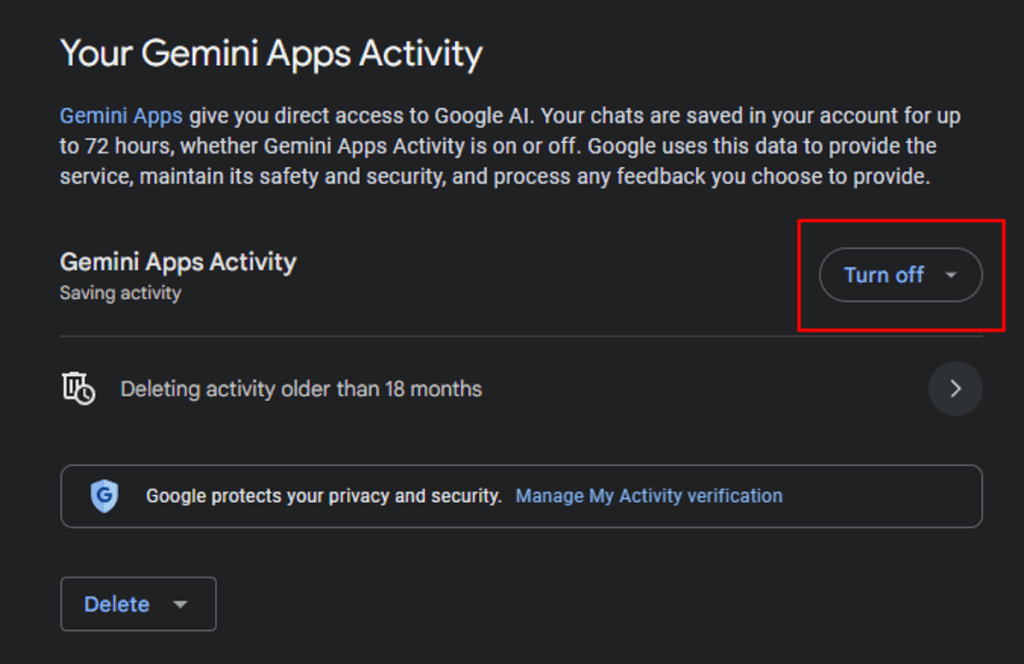 For ChatGPT → Go to: Settings → Data Controls → Turn off “Improve the model for everyone” 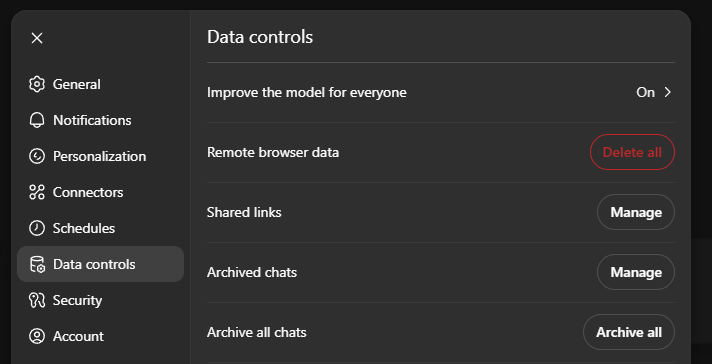 → Turn off “Improve the model for everyone” 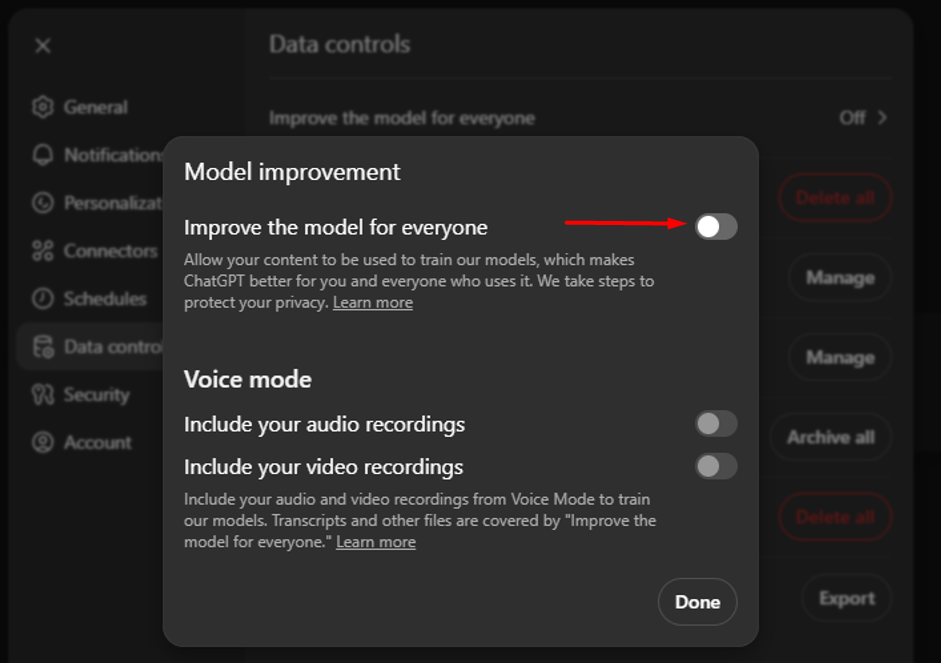 This disables training without limiting functionality. Next: Personalize Your AI ExperienceThere are 2 levels of personalization: A. System-Level Personalization In ChatGPT, click Customize ChatGPT.  → Enable for new chats → Add basic info about who you are and what you’re working on 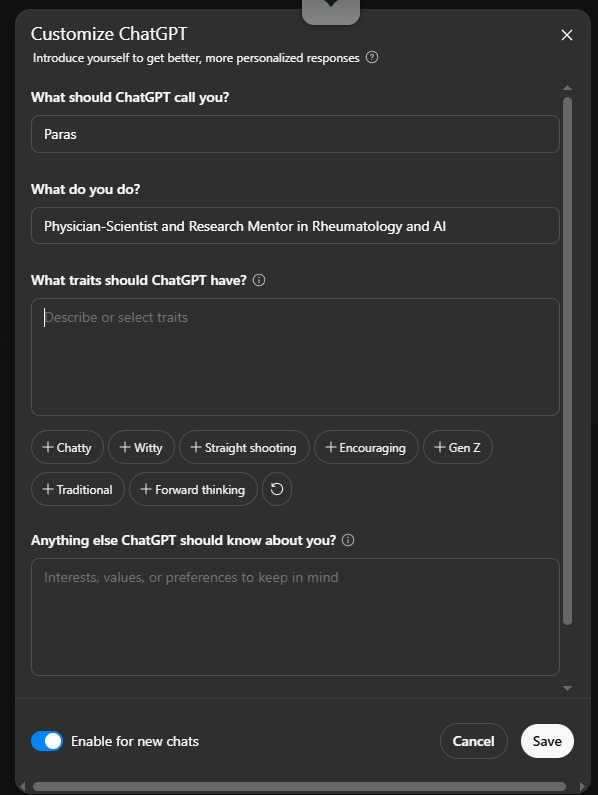 Why I don’t use this much: My work spans roles—researcher, clinician, teacher. Each with different goals, language, and context. So I prefer something more flexible… B. Project-Level Personalization (Recommended) This is where things get powerful. ChatGPT and Claude let you create projects—each with its own set of instructions and reference files. Here’s how I use it: 1. Click “New project” in the sidebar 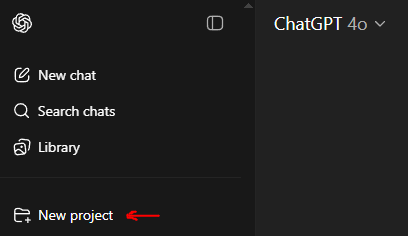 → Name your project → Click “Create Project” 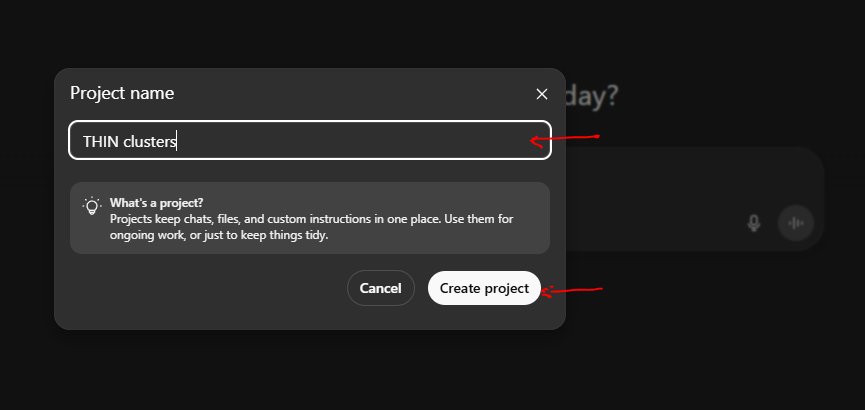 → Add project-specific instructions 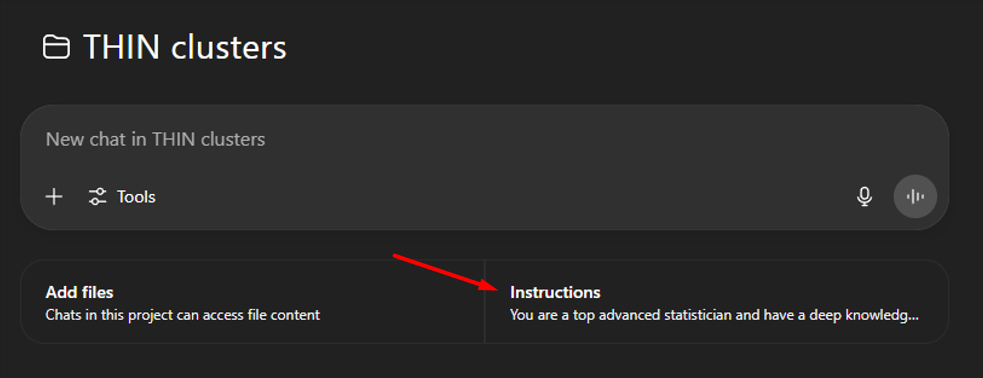 Example Let’s say I’m troubleshooting my code in Stata and R and interpreting results for a PsA project in the UK THIN database. My project instructions might look like this: You are a top advanced statistician and have a deep knowledge of THIN database and psoriatic arthritis, psoriasis, axial spondyloarthritis and their comorbities. We have used the below methods for this study: METHODS:Study design and data source. Prospective, cohort study from the UK THIN database. Patient population. PsA, PsO, and AxSpA patients ≥ 18 years Separate PsO, PsA, and AxSpA cohorts were created. Inclusion/Exclusion Criteria:
Age, sex, and time in cohort matched controls to cases 1:5 Outcome: Morbidities were defined by≥1 Read code in THIN. A list of morbidities was curated a priori based on clinical relevance and prior reports. Multimorbidity clusters at years 1 and 5 of PsA, PsO, or AxSpA diagnosis We defined multimorbidity as the presence of ≥2 morbidities (MM2+) and substantial multimorbidity as ≥5 morbidities (MM5+). In order to avoid overestimating the multimorbidity in patients with the disease, we did not include the disease itself (or defining features such as psoriasis in patients with PsA, or back pain in patients with axSpA) as one of the conditions when calculating morbidity counts. The total number of morbidities or chronic conditions present (0 to 40) was also calculated to represent the burden of multimorbidity. Multimorbidity clusters or phenotypes were identified using K-median clustering. The optimal number of clusters (k) was determined using a scree plot of the sum of squared errors (SEE), by choosing the “elbow” of the plotted line (i.e. the value of k where we start to have diminishing returns by increasing the value of k). The multimorbidity clusters were named based on the predominant comorbidity or EMM within the cluster and across the different clusters (Supplementary table). The baseline characteristics of the clusters were compared. To ascertain the stability of the clusters, sensitivity analyses were performed including comorbidities and EMMs at multiple time points (1 year and 5 years following the incidence of the index disease). 2. Upload your references Click “Add files” in the project sidebar. You can upload up to: → 20 files per project (ChatGPT Plus) → 40 files (Pro tier, $200/month) 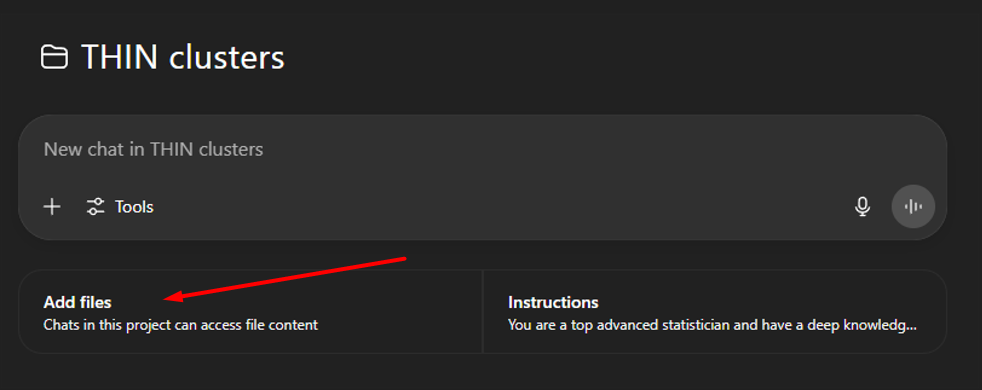 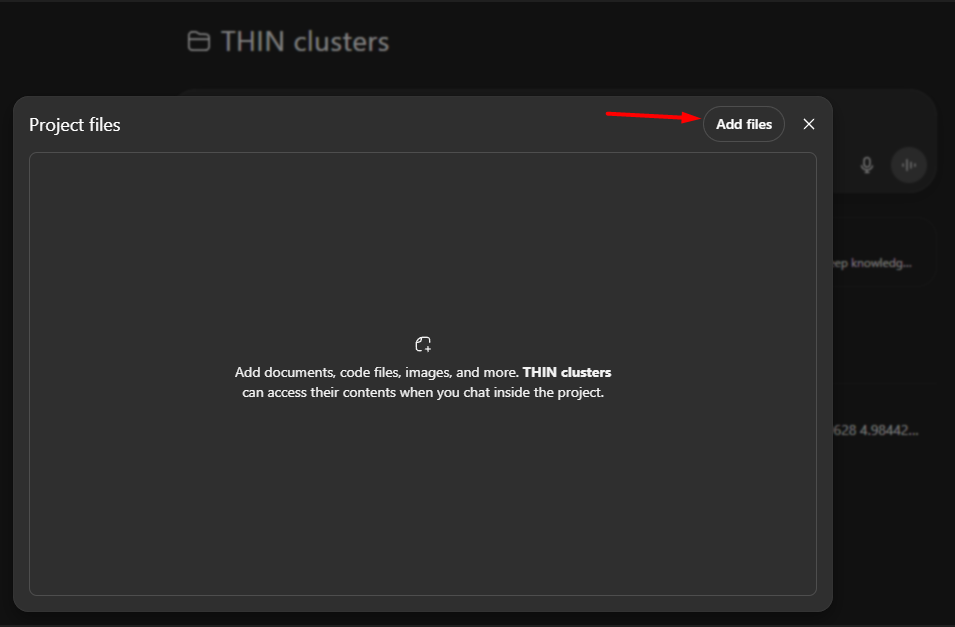 3. Enable Memory (Optional but Helpful) Click Settings → then open the Personalization tab. 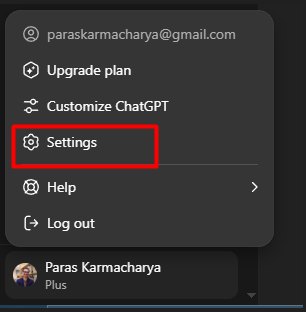 Turn on:
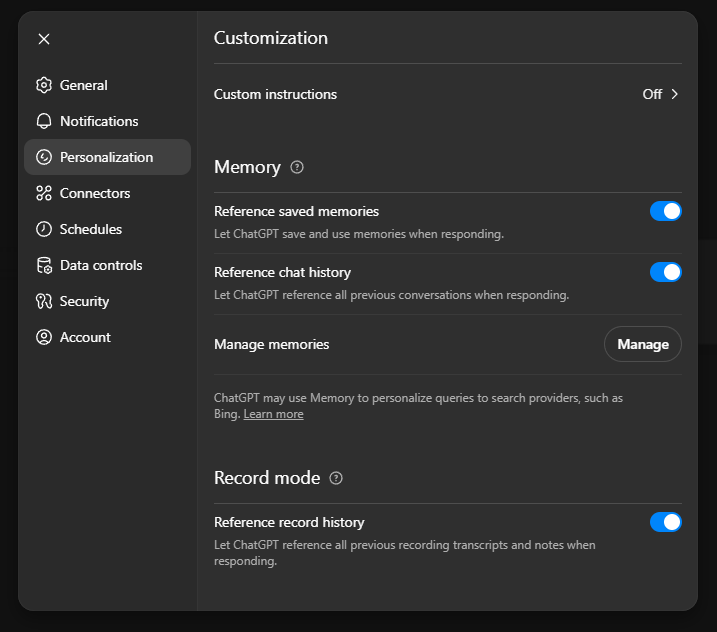 It’s still evolving, but I’ve found memory helps with style, tone, and recall of past edits. If you want a one-off chat with no memory, turn on “Temporary Chat” before you begin (right upper corner).  Step 3: Use Deep Research (Not Just Chat)When I’m working in a new area—something just outside my domain, I don’t rely on surface-level AI summaries. Instead, I use what I call deep research mode. Here’s what that looks like in practice: Previously, my go-to strategy was simple: → Find 3 recent review articles from top journals. The problem with that is… Those reviews might not answer the exact questions I have. Or they’re outdated. Or too broad. Deep research solves that. Use AI to Synthesize Literature—Not Just Summarize ItLet’s say you’re writing the background section of a grant. Or comparing treatment response across multiple trials. Or investigating a biomarker’s role in disease diagnosis or prognosis. Here’s what to do instead of asking “Summarize this paper”:
Example prompt: “Give me a 500-word synthesis of key themes from these 6 papers with proper citations. Focus on differences in study design and outcome definitions.” Where to Find Deep Research ModeIn ChatGPT → Click on Tools → Select Deep Research 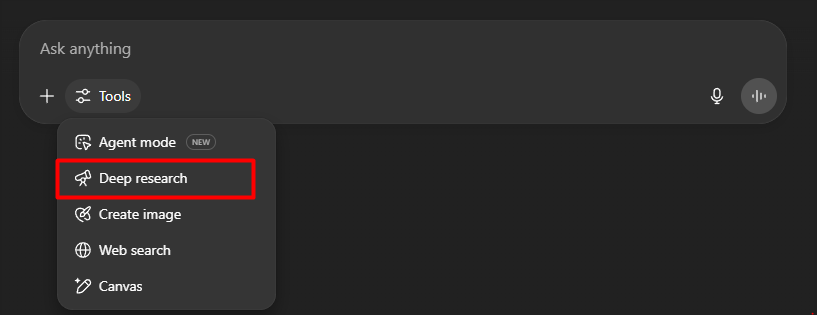 In Gemini → Click on Deep Research  NOTE:
Although expensive, I do find that ChatGPT Deep Research is more focused and I like it more. But you need to use your credits wisely. How I Actually Use It
Caveat: Still Requires Human OversightDeep research reports are more accurate than casual AI chat—but they’re not perfect.
Still, it’s a huge improvement over juggling 20 PubMed tabs at 1 a.m. This is not just faster. It’s a better way to think. Step 4: Work the Way You Think—Multimodal + VoiceMost people don’t know this: You can talk to your AI like a colleague. Not in some cheesy, voice-assistant way. I mean real-time coaching and brainstorming while walking, driving, or thinking aloud. But for real-time coaching, problem-solving, and brainstorming—while walking, commuting, or thinking out loud. That’s now possible. Try Voice Mode in ChatGPT or GeminiJust open the app on your phone. → Tap the microphone → Speak freely  No perfect grammar required. It captures your intent surprisingly well. Or Just Dictate Instead of TypingYou don’t need full voice mode to think aloud. Tap the microphone icon next to the prompt box and dictate.  I actually prefer this method. It’s faster, more fluid, and feels like a collaborative whiteboard session. How I Use This Mode
Think of this like having your own research sounding board. Your own Dr. Watson—if you’re the Sherlock type.
This isn’t futuristic anymore. It’s just underused. Step 5: Create varied outputs: Code, Documents (e.g., ppt), and ImagesAI is not just for writing paragraphs or answering questions. It can now help you generate:
And the best part is… You can ask for all of these using plain language. Image GenerationChatGPT has the most reliable and controllable image tool right now. Gemini uses two systems:
Claude doesn’t generate images yet. I’ve used ChatGPT’s image tool to mock up:
No, these won’t be publication-ready. But they’ll help you get started—and refine your thinking. Example: Conceptual Figure for PsA Clinical ClustersFor a recent paper on PsA phenotype clusters, I gave ChatGPT (o3) this simple prompt: And it generated a downloadable PowerPoint with a clean, editable figure. 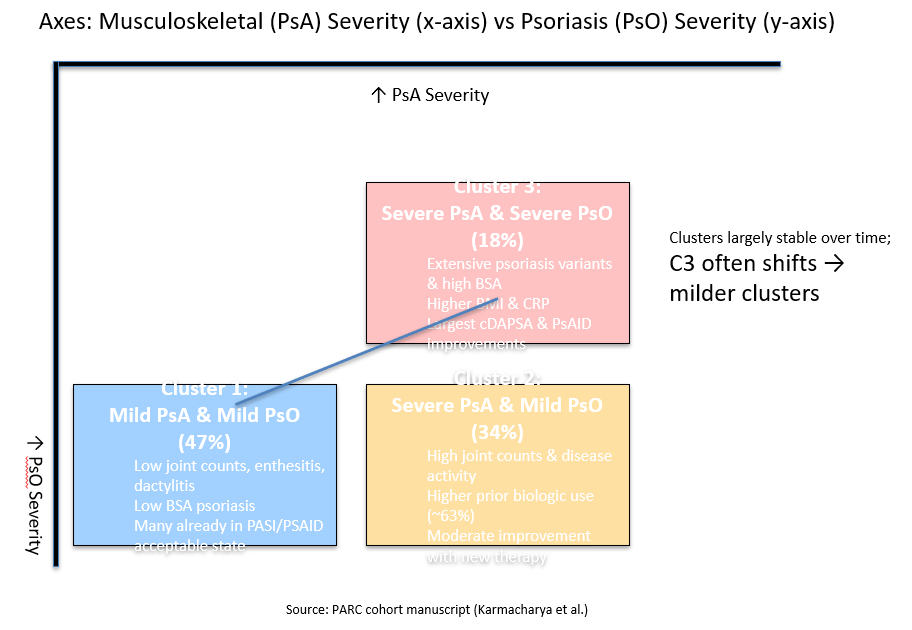 Is this perfect? No. (Obviously needs some formatting). But it visualized an angle I hadn’t considered – and frankly I found it very innovative. Tip: Use “Canvas” Mode for Richer OutputIn ChatGPT or Gemini, enable Canvas (or equivalent) when you want the AI to:
Claude, while it doesn’t do visuals, is excellent for structured document creation—like detailed tables or well-formatted PDFs. Think Beyond TextI often use AI to:
The more you treat AI like a creative collaborator, the more useful it becomes. Step 6: Learn Prompting by DoingYou don’t need to master “prompt engineering.” But you do need structure. The more clearly you frame your ask, the better the output. Here’s the simple framework I use (and teach) to make prompting fast and effective: The 5-Part PERSONAL GOAL Framework→ Persona(l): Who should the AI act as? → Goal: What outcome are you aiming for? → Output format: What do you want back? → Avoid: What should it not do? → Lens of context: What background info should it consider? Example
That prompt gets you a high-signal, well-structured, reviewer-like response—fast. 5 Additional Tips to Start Strong1. Give context. AI can’t read your mind. Share background, PDFs, tables, blurbs—whatever helps. Claude and ChatGPT can read uploaded files. Gemini can pull from Gmail or Docs. But I still prefer feeding context manually. 2. Be specific about your ask. Instead of: → “Write a cover letter.” Try: → “I’m applying for an academic rheumatology position. Here’s the job description and my CV. Write a 1-page cover letter emphasizing NIH funding, mentorship experience, and clinical strengths.” 3. Break it down. Don’t throw the whole manuscript in. Work step-by-step. Start with one paragraph. Ask for feedback on clarity, or logic, or tone—not all at once. Example: → Instead of “improve clarity,” say: “Clarify how the mechanism of action connects to the primary outcome.” 4. Ask for volume. AI doesn’t get tired. Need 50 title options? Ask. Want 10 ways to reframe a table? Ask. Try your prompt across ChatGPT, Claude, and Gemini—and compare. Chances are, one will surprise you. 5. Use branching. All 3 models let you create branches when editing a past message. Try a new angle—like: → “Now give this feedback from a patient-partner lens” → “Now rewrite for a different journal tone” → “Now revise like a statistical reviewer” No need to start over. Troubleshooting
Still happen—especially if you give vague instructions or use faster models. Don’t trust citations blindly. Always check specific facts, references, and numbers.
Ask “why?” Push for deeper reasoning. Request rewrites. You’re not using a vending machine.
Click “Show reasoning.” It often reveals helpful structure—even if the conclusion needs work. Use It on Real WorkPlaytime is over. Time to apply it to something that matters. → Use the powerful model. Feed it a real problem. Add full context. Ask for a detailed output (e.g., response to reviewers, table format, discussion draft). Iterate until it works. → Try Deep Research. Pick a topic you’re preparing a manuscript or talk on. See how it handles synthesis, comparisons, or citations. → Turn on voice mode. Use it while walking or commuting. Brainstorm aims, outline papers, think aloud with feedback. Most researchers still treat AI like search engines. One prompt. One reply. Done. But now you know better. Use it with real documents. Ask better questions. Explore multiple outcomes. The biggest difference between casual users and serious clinical researchers isn’t intelligence or tech skill. It’s this: ↳ They’re not asking what the tool can do. ↳ They’re asking: “What can this tool help me do better—right now?” What’s one thing you could try AI on today that you haven’t yet? The post How to Start Using AI for Research Today: My Minimalist Approach for Maximal Impact (Without the Overwhelm) appeared first on Rising Researcher Academy. Best wishes, Paras Paras Karmacharya, MD MS Founder @Rising Researcher Academy |
 Use Deep Research mode
 Hallucinations
RISING RESEARCHER ACADEMY