How to break the AI productivity paradox: Backwards design is the master key
|
How to break the AI productivity paradox: Backwards design is the master key Read at RisingResearcherAcademy.com. You are trapped in the AI productivity paradox. And the weird part is you feel like you’re winning. You prompt. AI spits out text in 6 seconds. You get that little dopamine hit. Then you read it and think… Not quite. So you prompt again. And again.
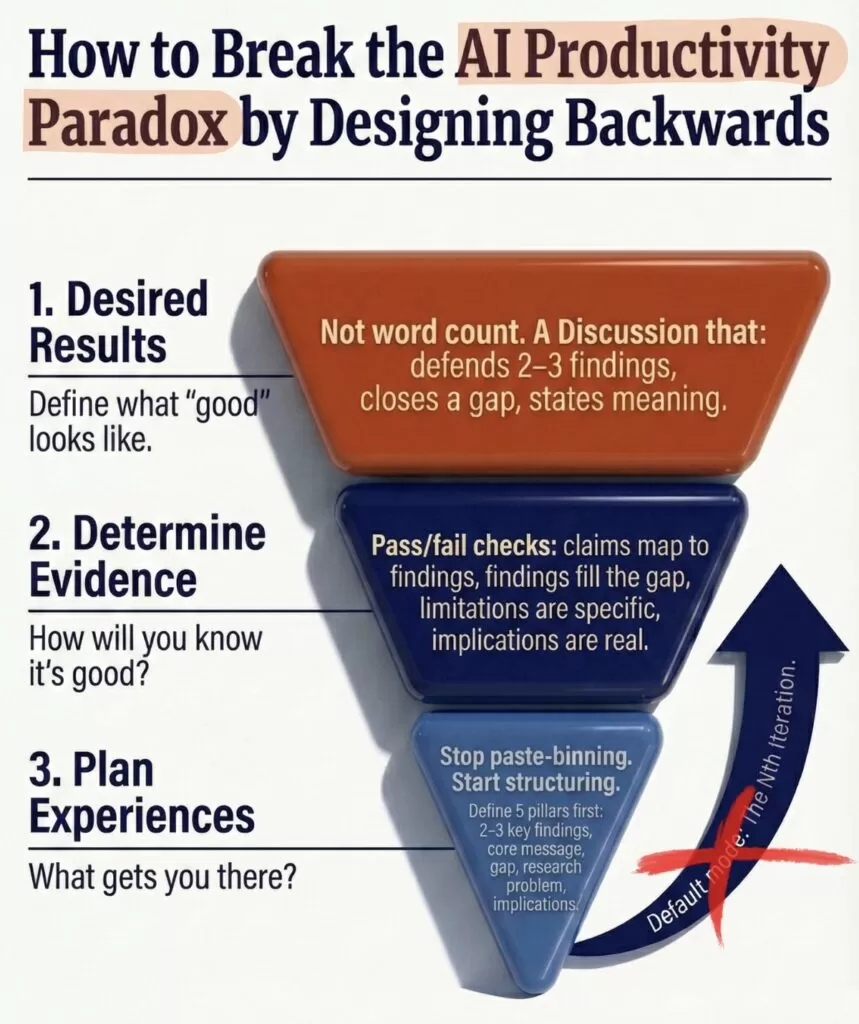
That’s not a workflow. That’s a slot machine. You’re waiting for an outcome you can’t define. If your thinking is fuzzy, your draft will stay generic. AI isn’t confused. Your thinking is. In an RCT of 16 software developers, they expected AI to speed them up. Even after using it, they still believed they were faster. But objectively, tasks took longer (19%). A perception gap that big should make every researcher pause. Here’s the fix: Backwards design is key to break this paradox.Most people start here: “AI, write my Discussion.” That’s the lazy approach. Backwards design flips it. It forces you to stop “vibing” with the model. And start acting like the showrunner. You set the vision. AI becomes your production crew. The “Design Backwards” framework in commonly used education and curriculum design: Start with the outcome, define what counts as evidence, then plan the activities. Here’s how we can apply it to research when working with AI: 1) Desired ResultsDefine what “good” looks like before you start working with AI. Not “900 words.” Not “make it sound academic.” Instead, define the job of the Discussion:
If you can’t define “good,” AI will default to generic. Because at its core, an LLM is optimizing for “likely next words,” not “your dataset’s truth.” And without your constraints, it will drift toward the safe middle. The average. The bland. The thing that sounds right to everyone and commits to nothing. 2) Determine EvidenceHow will you know the draft is good? This is the step most people skip. They don’t set a standard. So they iterate forever. Instead, build a simple pass/fail checklist. Not vibes. Evidence. Create pass/fail evidence:
This is what turns “I’ll know it when I see it” into “I’ll know it because it passed the rubric.” And it protects you from the most common AI failure mode: Confident filler (popularly referred as “AI slop”). 3) The PlanNow design the inputs and workflow that get you there. Context ≠ a paste-bin. Notes. Results. Random paragraphs. “Stuff I might cite later.” That’s static. AI is a mirror. It won’t magically create structure. It reveals the lack of it. So give it structure. Before prompting, fill these 5 manuscript pillars:
Strong pillars in → crisp draft out. One more thing that matters here. Control the context. You meander, the model meanders. You argue for 30 turns, and now it’s stuck in a weird frame you accidentally created. Sometimes the best move is a fresh thread with a tight prompt and only the pillars it needs. Less memory. More precision. That’s backwards design in practice. You’re not “chatting.” You’re directing. You’re managing. You’re building a draft on purpose.
Desired Results, Evidence, or Planning? PROMPT OF THE WEEKImprove Clarity and Readability P.S. Research Boost walks you through the manuscript pillars step by step with your desired result in mind, so the draft comes from your work, not AI guesswork. Researcher-first, always. Sign up for a free trial here: http://researchboost.com/ The post How to break the AI productivity paradox: Backwards design is the master key appeared first on Rising Researcher Academy. Best wishes, Paras Paras Karmacharya, MD MS Founder @Rising Researcher Academy |
 If your AI drafts feel generic, which step are you skipping most:
RISING RESEARCHER ACADEMY